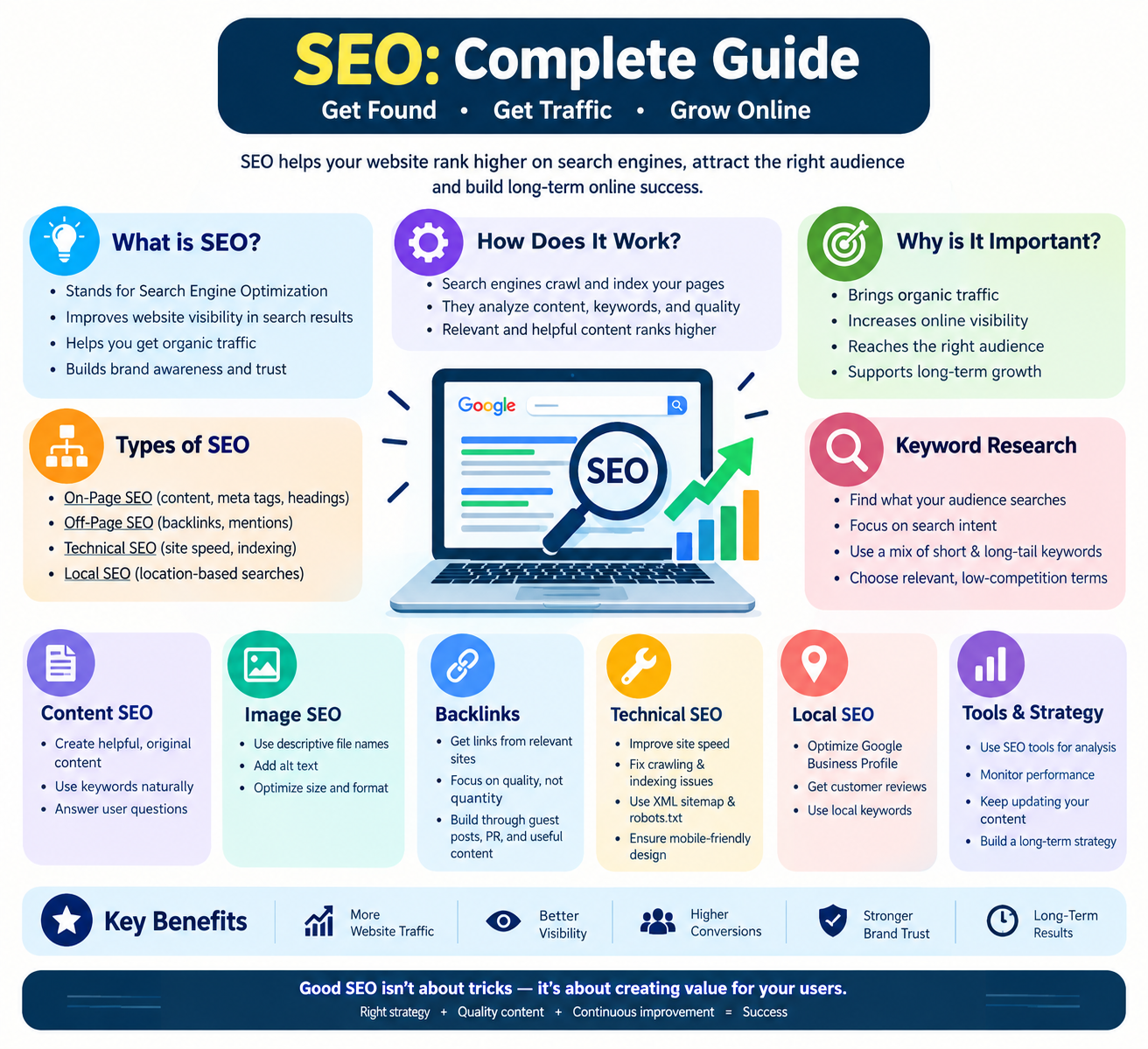
In today’s digital world, having a website is not enough. If you want people to find your website on Google and other search engines, you need SEO (Search Engine Optimization).
SEO helps improve a website’s visibility in search results, attract relevant organic traffic, build online visibility, and support long-term digital growth.
What Is SEO?
SEO stands for Search Engine Optimization.
SEO is the process of improving a website and its content so that search engines can better understand, crawl, index, and potentially rank its pages for relevant search queries.
In simple words, SEO helps search engines understand:
- What your website is about
- What your individual pages are about
- Which searches your content may be relevant to
- Whether your content provides value to users
The main goal of SEO is to increase organic search visibility and attract relevant visitors without relying entirely on paid advertising.
How Does SEO Work?
When someone searches for something on Google, the search engine tries to provide the most relevant and useful results.
Search engines use many systems and signals to discover, understand, organize, and rank web pages.
An effective SEO strategy generally focuses on:
- High-quality content
- Relevant keywords
- Search intent
- Website structure
- Internal links
- Page experience
- Mobile usability
- Technical SEO
- Website accessibility
- Relevant backlinks
- Content freshness where appropriate
SEO is therefore much more than simply adding keywords to an article.
Why Is SEO Important?
SEO can be important for businesses, bloggers, e-commerce websites, service providers, and organizations.
1. Increase Organic Traffic
A website that appears for relevant searches can receive visitors through organic search results.
2. Improve Online Visibility
SEO can help your website become more visible when potential customers search for topics, products, or services related to your business.
3. Reach Relevant Users
Good keyword research and search-intent analysis help you create content for people who are actually interested in your topic or offering.
4. Build Brand Awareness
Consistently publishing useful content can increase awareness of your brand.
5. Support Long-Term Growth
SEO is generally a long-term strategy. Instead of depending only on advertisements, businesses can work toward building sustainable organic visibility.
Types of SEO
SEO can be divided into several important areas.
1. On-Page SEO
On-page SEO refers to optimization performed on individual web pages.
Important elements include:
- Page titles
- Meta descriptions
- Headings
- Content
- Keywords
- Search intent
- URLs
- Internal links
- Images
- Structured content
The goal is to make the page useful for visitors and easier for search engines to understand.
2. Off-Page SEO
Off-page SEO focuses on activities outside your own website that can contribute to your website’s reputation and visibility.
Common examples include:
- Relevant backlinks
- Digital PR
- Brand mentions
- Guest contributions
- Business citations
- Industry references
The focus should be on earning relevant and natural references rather than simply creating a large number of links.
3. Technical SEO
Technical SEO focuses on the technical aspects of a website.
It can include:
- Crawling
- Indexing
- XML sitemaps
- Robots.txt
- HTTPS
- Canonical URLs
- Website architecture
- Mobile usability
- Page performance
- Structured data
Technical SEO helps search engines access and understand your website efficiently.
What Is Keyword Research?
Keyword research is the process of discovering and analyzing the words and phrases people use when searching for information, products, or services online.
For example, if your website is about SEO, possible keywords include:
- SEO
- What is SEO
- SEO tips
- SEO strategy
- SEO techniques
- How to improve Google ranking
However, keyword research is not only about finding keywords with high search volume.
You should also consider:
- Search intent
- Competition
- Relevance
- Business value
- Topic coverage
- User needs
Types of Keywords
Short-Tail Keywords
Short-tail keywords are generally short and broad search terms.
Examples:
- SEO
- Marketing
- Backlinks
- Keywords
- Digital marketing
These keywords can have high search demand but may also be highly competitive and less specific.
Long-Tail Keywords
Long-tail keywords are more specific search queries.
Examples:
- How to do SEO for a new website
- How to rank a website on Google
- How to conduct keyword research
- How to create SEO-friendly content
- How to build backlinks for a website
Long-tail queries can help you target specific search intent.
What Is On-Page SEO?
On-page SEO involves optimizing the content and HTML elements of a webpage.
Important on-page SEO factors include:
Title Tag
The title should accurately describe the page and clearly communicate its topic.
Meta Description
A useful meta description can summarize the page and encourage users to click the result.
Headings
Use clear headings such as H1, H2, and H3 to organize your content.
Content
Create original, useful, accurate, and easy-to-understand content that satisfies the user’s search intent.
Internal Linking
Link relevant pages within your website to help users discover related content and help search engines understand relationships between pages.
Image Optimization
Use descriptive image file names, relevant alt text where appropriate, and optimized image sizes.
What Is Off-Page SEO?
Off-page SEO focuses on signals and activities beyond the website itself.
One of the most commonly discussed areas is link building.
A backlink is a link from another website to your website.
However, SEO is not a numbers game where more backlinks automatically means better rankings.
Quality, relevance, context, and natural link acquisition are important considerations.
What Is a Backlink?
A backlink is a hyperlink from one website to another website.
For example, if Website A links to a page on Website B, Website B receives a backlink from Website A.
Backlinks can help search engines discover pages and can contribute to a website’s authority and reputation when they are relevant and naturally earned.
Useful backlink opportunities can include:
- Industry publications
- Relevant blogs
- Editorial mentions
- Digital PR
- Business directories
- Resource pages
- Original research
Avoid creating large numbers of low-quality or irrelevant links simply to manipulate rankings.
What Is Technical SEO?
Technical SEO focuses on making your website technically accessible and understandable to search engines.
Important technical SEO areas include:
- Website crawling
- Website indexing
- XML sitemap
- Robots.txt
- Canonicalization
- HTTPS
- Mobile usability
- Website architecture
- Page speed
- Structured data
- Duplicate content management
- Redirects
- Broken links
A technically healthy website provides a strong foundation for other SEO activities.
What Is Local SEO?
Local SEO focuses on improving visibility for location-based searches.
For example:
- SEO agency in Delhi
- Digital marketing agency in Varanasi
- Best restaurant near me
- Dentist in Mumbai
- Web development company in India
Local SEO can involve:
- Accurate business information
- Google Business Profile optimization
- Local content
- Customer reviews
- Local citations
- Location-specific landing pages
- Relevant local links
What Is Content SEO?
Content SEO focuses on creating and optimizing content to satisfy users and relevant search intent.
Good SEO content should:
- Answer the user’s question
- Be easy to read
- Provide useful information
- Use relevant keywords naturally
- Have a clear structure
- Include useful examples
- Cover the topic appropriately
- Avoid unnecessary repetition
The goal should be to create content for people first, while making it understandable to search engines.
How to Write SEO-Friendly Content
Follow these steps to create SEO-friendly content.
Step 1: Understand Your Audience
Identify who you are writing for and what information they need.
Step 2: Perform Keyword Research
Find relevant search terms related to your topic.
Step 3: Understand Search Intent
Determine whether users want information, a product, a service, a comparison, or a specific solution.
Step 4: Create a Clear Structure
Use a logical hierarchy of headings and subheadings.
Step 5: Write Helpful Content
Focus on solving the user’s problem rather than simply increasing word count.
Step 6: Add Internal Links
Connect your article with other relevant pages on your website.
Step 7: Optimize Images
Use relevant images and appropriate descriptive alt text.
Step 8: Review and Update
Update information when it becomes outdated or when you discover opportunities to improve the content.
What Is Keyword Stuffing?
Keyword stuffing means using the same keyword excessively or unnaturally in an attempt to influence search rankings.
For example:
SEO is important. SEO helps SEO websites. SEO tips can improve
SEO. SEO services use SEO strategies.
SEO Strategy: Step-by-Step
A basic SEO strategy can follow these steps:
Step 1: Analyze Your Website
Check your existing pages, content, technical issues, and current search visibility.
Step 2: Identify Your Target Audience
Understand what your potential customers or readers are searching for.
Step 3: Perform Keyword Research
Build a list of relevant keywords and group them by topic and search intent.
Step 4: Create a Content Plan
Develop pillar pages and supporting articles around related topics.
Step 5: Improve On-Page SEO
Optimize titles, headings, content, URLs, images, and internal links.
Step 6: Fix Technical Issues
Resolve crawling, indexing, mobile usability, performance, and structural problems.
Step 7: Build Website Authority
Earn relevant backlinks, mentions, citations, and references through useful content and legitimate promotion.
Step 8: Monitor Performance
Track organic traffic, rankings, conversions, indexed pages, and other relevant SEO metrics.
Step 9: Improve Existing Content
Conclusion
SEO is a long-term digital marketing strategy that focuses on improving a website’s visibility in organic search.
Successful SEO involves much more than keywords. It combines quality content, keyword research, search intent, on-page SEO, technical SEO, internal linking, relevant backlinks, local optimization, and continuous improvement.
No responses yet